
What Is an Ammonite? The Ancient Ocean Animal Inside the Spiral
An ammonite looks as though time curled itself into a fist and fell asleep.
The shell turns inward, chamber after chamber, a pattern so perfect that it can feel symbolic before we know anything about the creature that made it. But ammonites were not stones, snakes, or sea snails. They were living ocean animals, members of the cephalopod family, related to modern squid, octopuses, cuttlefish, and nautiluses.
They swam through ancient seas for hundreds of millions of years.
Then the animals disappeared, the oceans changed, sediment closed over their shells, and geology began the slow work of remembering them.
What Was an Ammonite?
Ammonites were extinct marine mollusks with chambered shells. Their wider group, Ammonoidea, first appeared roughly 450 million years ago, while the “true ammonites” familiar from many Jurassic and Cretaceous fossils appeared later.
Most ammonites vanished about 66 million years ago during the same mass-extinction event that ended the age of non-avian dinosaurs.
They lived in oceans around the world, generally in shallower marine environments. Some were only a few millimeters across. Others grew wider than a person is tall.
Their closest visual comparison is the living nautilus, although ammonites were more closely related to squid and octopuses. The animal occupied the newest, outermost chamber of its shell. The older chambers behind it helped regulate buoyancy, allowing the ammonite to move through the water without carrying the full weight of a solid shell.
The spiral was a home, a flotation system, and a lifelong record of growth.
Why Does an Ammonite Shell Have Chambers?
An ammonite did not begin life inside a full-sized shell. It added new chambers as it grew, moving forward into each larger living chamber and sealing the older space behind it.
When a polished ammonite is cut into matching halves, that architecture becomes visible. A line of rooms curves toward the center, each one smaller than the last, like a hallway leading backward through the animal’s life.
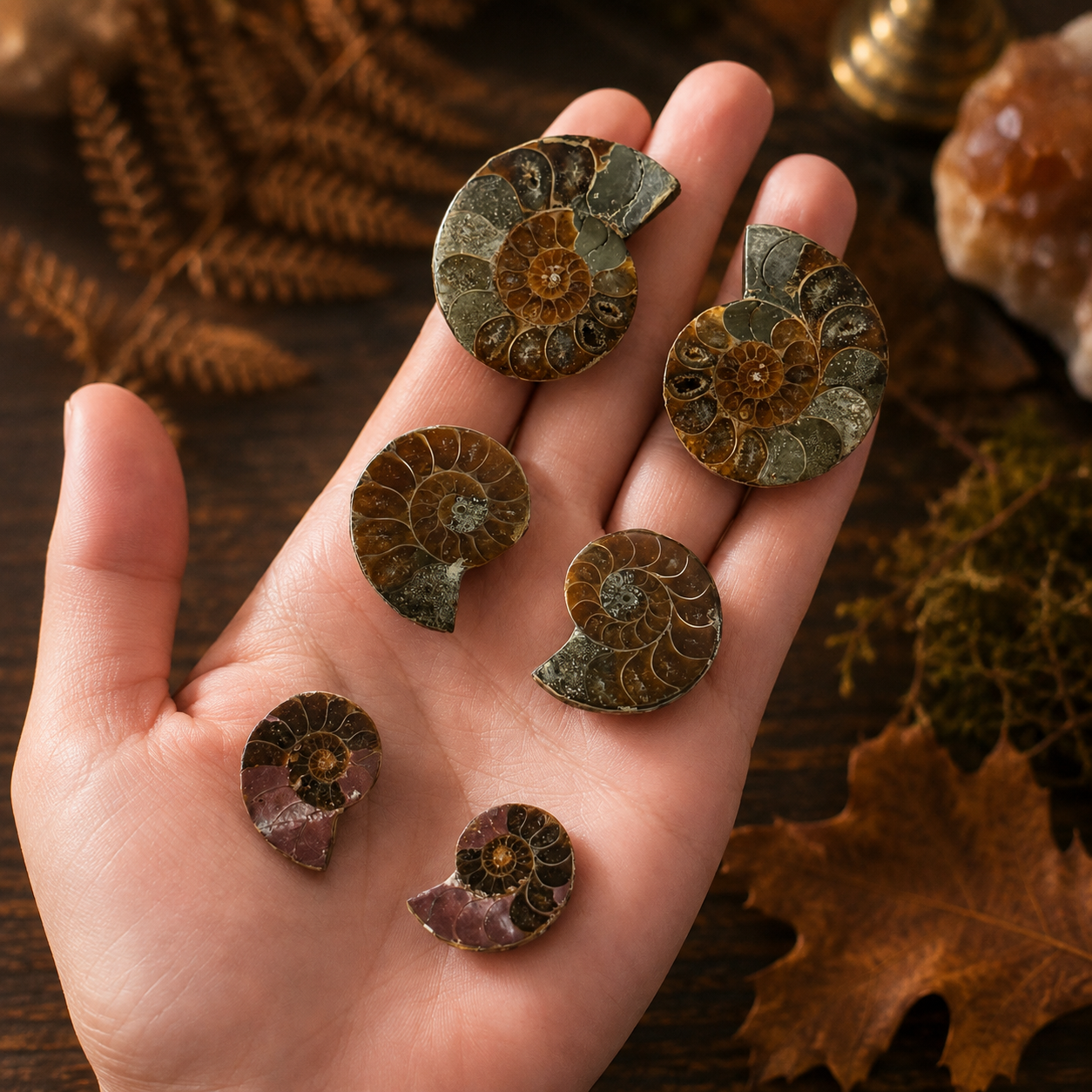
The complex boundaries between chambers are called sutures. Their shapes can be wonderfully intricate, branching across the shell like frost, fern leaves, rivers viewed from the sky, or maps of countries that never existed.
Scientists use shell shape, ribs, spines, sutures, size, and locality to distinguish ammonite groups and species.
How Does an Ammonite Become a Fossil?
Fossilization begins with an unlikely piece of luck.
After the animal died, its shell needed to escape scavengers, waves, dissolution, and ordinary decay long enough to be buried. Mud, sand, or silt covered it. Over time, additional sediment accumulated and hardened into sedimentary rock.
Sometimes the original shell material survived. Sometimes minerals replaced it. Sometimes the shell dissolved and left a hollow mold, which later filled with sediment or minerals to create a cast.
This is why ammonites can look so different from one another. One may retain pearly shell layers. Another may be filled with calcite. Another may preserve only the form of the shell in dark stone.
The fossil is not always the original shell. Sometimes it is the space where the shell once was, remembered in mineral and rock.
Why Are Some Ammonites Iridescent?
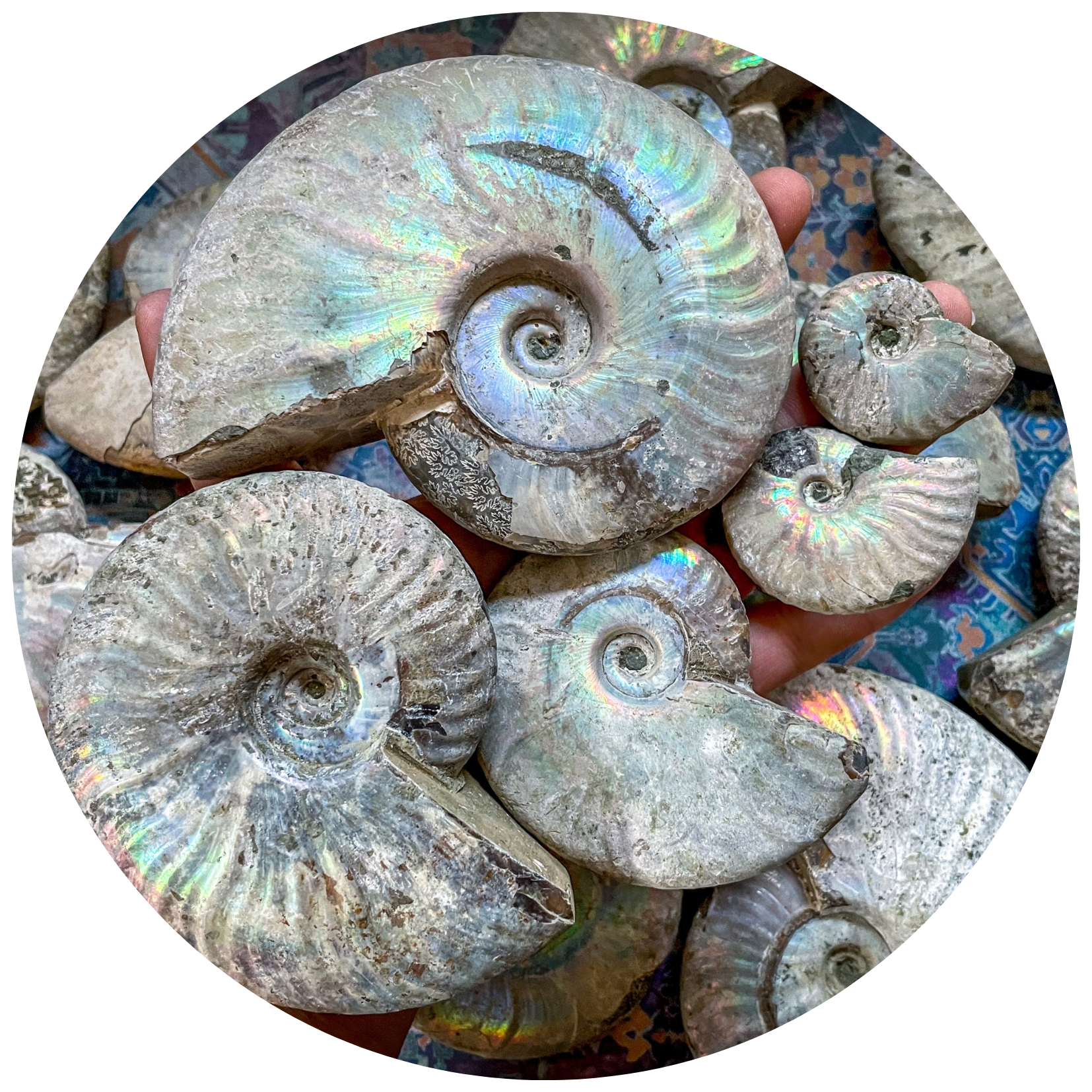
Some ammonite fossils retain thin layers of original aragonite shell material. When light meets those finely layered structures, it can interfere and separate into color, producing flashes of red, green, gold, blue, or violet.
A rainbow ammonite seems to keep a little piece of the ocean’s light trapped under its surface.
The word ammolite is often used for gem-quality iridescent ammonite shell, especially material from Alberta, Canada. Not every colorful ammonite should automatically be identified as Canadian ammolite, however. Locality, preservation, stability, treatments, and trade terminology matter.
The published Mandala Gems rainbow ammonite specimens from Madagascar show natural iridescence, while the polished ammonite fossils reveal the spiral through a smooth earth-toned finish.
Different preservation. Same ancient sea.
Why Are Ammonites Important to Paleontologists?
Ammonites evolved quickly, spread widely, and left abundant shells in marine sedimentary rocks. Those traits make them useful index fossils.
When scientists identify a particular ammonite species in rock layers from different locations, they can correlate those layers and estimate their relative ages. Entire sections of Mesozoic rock have been divided into ammonite zones.
A fossil small enough to fit in your hand can therefore assist in reading an entire landscape.
The spiral is beautiful, yes. It is also a geological clock.
How Should You Choose an Ammonite Fossil?
Choose the specimen that makes you curious.
For a natural-history collection, look for a clearly described locality, visible ribs or sutures, and honest information about polishing, cutting, stabilization, repairs, or coatings.
Choose a whole fossil if you love the exterior shell shape. Choose a matching polished ammonite pair if you want to see the internal chambers. Choose an iridescent specimen if light and preserved shell structure are what call you closer.
Tiny pits, mineral veins, incomplete edges, and changes in color are often part of the fossil’s history. Perfection is not really the point here.
It survived extinction and several geological eras. We can forgive a rough edge.
How Do You Care for an Ammonite?
Keep ammonites away from prolonged water exposure, household chemicals, ultrasonic cleaners, and sudden temperature changes. Iridescent shell layers can be especially delicate.
Dust gently with a dry, soft brush or microfiber cloth. Support larger specimens from beneath, and keep paired halves from knocking together. A padded stand or stable shelf is safer than a crowded bowl.
Most importantly, ask about coatings, fillers, repairs, and stabilization before experimenting with any cleaning method.
The Ocean Inside the Stone
An ammonite is the remains of an animal, the architecture of a shell, a record of vanished water, and a tool scientists use to arrange deep time.
The creature is gone.
The rooms remain.
And the spiral keeps turning inward, holding an ocean that has not existed for millions of years.
Sources: Natural History Museum: What Is an Ammonite?, Natural History Museum: How Fossils Form