
What Is Flower Agate? The Geology Behind Its Blossoming Plumes
Flower agate looks as though a garden began growing inside a stone and simply decided to stay there.
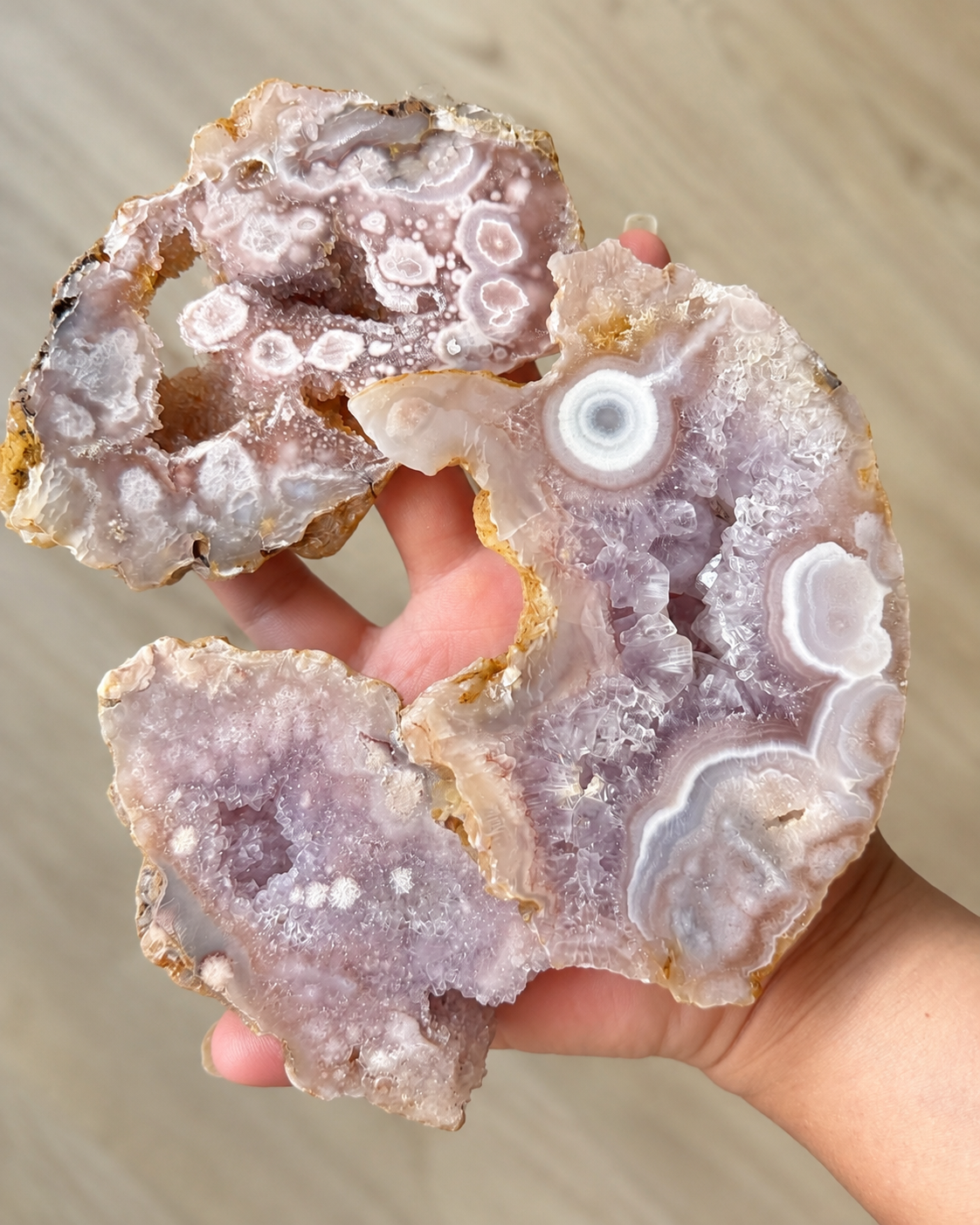
Pale plumes drift through translucent chalcedony. Some resemble cherry blossoms suspended in mist, while others look like tiny seeds, clouds, coral branches, or petals opening beneath water. The patterns feel botanical, but flower agate contains no actual flowers. What we are seeing is mineral growth, preserved layer by patient layer inside silica.
Flower agate is a modern trade name rather than a formally recognized mineral species. The material belongs to the broad chalcedony and agate family, and the name describes its appearance: translucent stone filled with soft, flower-like formations.
What Is Flower Agate Made Of?
Flower agate is primarily chalcedony, a compact form of silica made from quartz crystals so tiny that they cannot be distinguished with the naked eye.
The term agate is generally used for patterned chalcedony, especially when the material displays bands, zones, plumes, moss-like structures, or other distinct internal landscapes. The United States Geological Survey describes chalcedony as a broad family of cryptocrystalline quartz that includes agate, jasper, carnelian, onyx, chrysoprase, bloodstone, and many other varieties.
In flower agate, pale inclusions and denser areas of chalcedony gather into shapes our minds recognize as blossoms. This visual resemblance is what gave the stone its romantic name.
The flowers are metaphors written by geology.
How Do the Flower-Like Patterns Form?
Agate commonly develops when silica-rich fluids enter cavities and fractures in rock. Over time, silica precipitates from those fluids and begins lining the open space.
This process does not happen all at once. Conditions change. Fluid arrives in pulses. Mineral concentrations shift, and variations in temperature, pressure, porosity, and timing influence each new layer.
Research published by the Gemological Institute of America explains that many agates form as silica-rich fluids repeatedly fill cavities from the outside toward the center. Changes in the fluids and formation environment help determine the stone’s bands, colors, widths, and internal patterns.
In plume and moss agates, growth is less orderly than the familiar concentric stripes of banded agate. Mineral matter may branch, gather, or spread through the chalcedony. The result can resemble leaves, moss, feathers, flames, or flowers even though it was created entirely through inorganic processes.
There is still mystery here. Scientists continue to study exactly how agate’s intricate textures develop, and gemological research notes that the complete formation mechanism remains surprisingly complex.
Is Flower Agate the Same as Cherry Blossom Agate?
The names flower agate and cherry blossom agate are usually used for the same general material. Sellers may choose one name or the other depending on the color and pattern of a particular piece.
“Cherry blossom agate” tends to describe specimens with especially soft pink, peach, or white formations. However, there is no universally regulated gemological boundary separating the two trade names.
This is why a careful listing should tell you more than the name alone. Look for locality information, accurate photographs, dimensions, natural variations, and disclosure of treatments when applicable.
Why Does Every Piece Look Different?
Agate records changing conditions as it grows. One area may be nearly transparent, another milky and dense. Some pieces hold isolated blooms floating inside open chalcedony, while others are crowded with overlapping plumes.
Cutting changes the view as well.
Imagine slicing through a three-dimensional cluster of mineral growth. One cut may cross the center of a plume and reveal a round blossom. Another may skim its edge and produce a feather, cloud, or branching shape. A polished slab becomes a window through a larger structure that once continued beyond the surface.
This is part of the pleasure of collecting flower agate. You are not choosing a repeated design. You are choosing one view into a mineral landscape that will never occur in precisely the same way again.
What Should You Look for When Choosing Flower Agate?
There is no single “best” pattern, but a few qualities are worth considering.
Visible depth
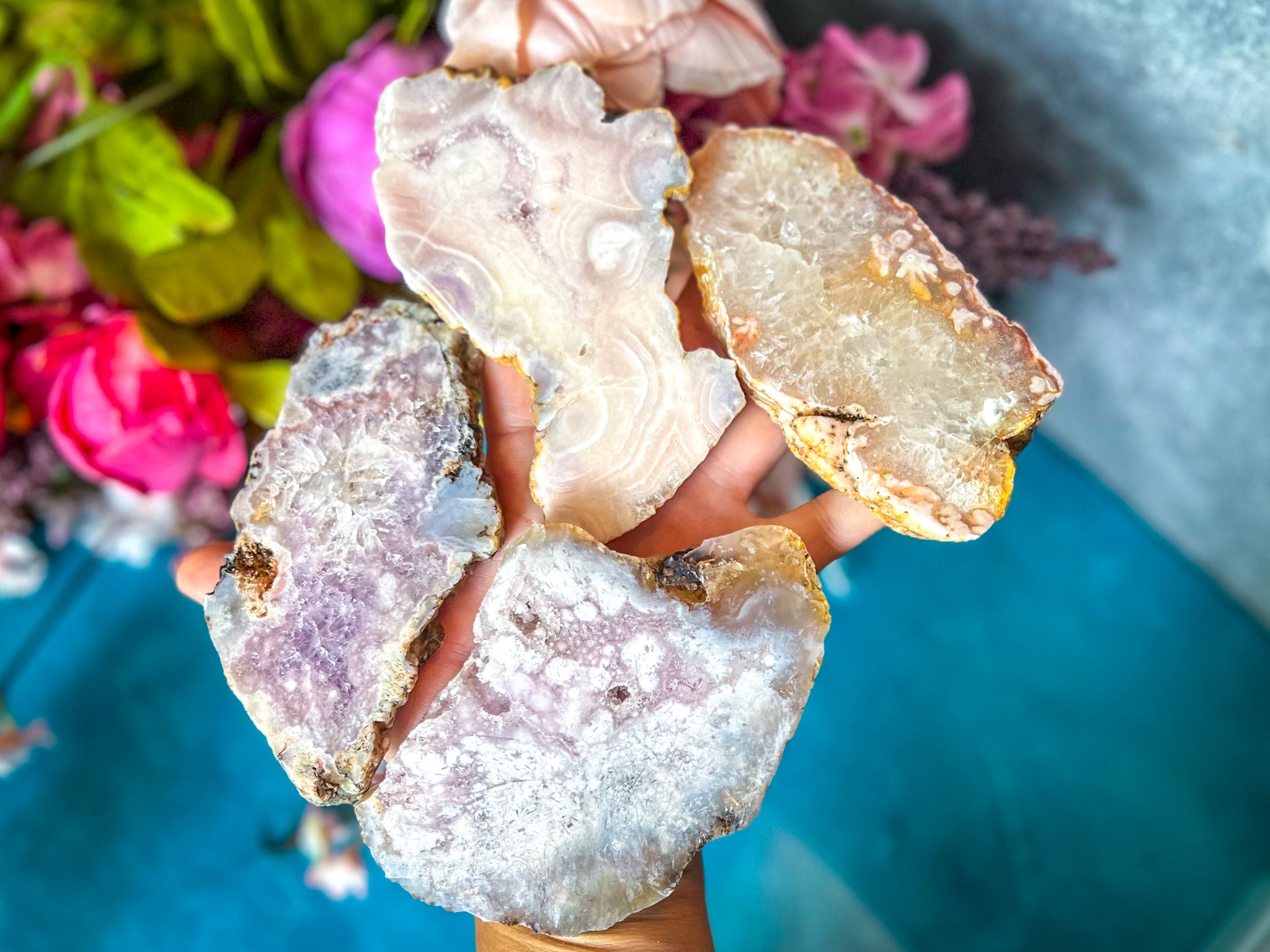
Look for specimens where the plumes appear at different levels inside the chalcedony. Depth makes the stone feel inhabited rather than printed upon.
Contrast
Soft white or pink formations are easier to see when surrounded by translucent gray, peach, lavender, or clear chalcedony.
Polish
A smooth polish helps light enter the stone and reveal its interior. Natural pits, small cavities, and rough edges are not necessarily flaws, especially on slabs that preserve part of the original exterior.
A pattern you actually love
One collector may want distinct round blossoms. Another may prefer foggy layers and half-hidden forms. The most beautiful specimen is often the one that keeps asking you to look again.
Explore the current Mandala Gems Flower Agate collection or view the Pink Flower Agate polished slices.
How Should Flower Agate Be Displayed?
Flower agate is especially beautiful near indirect daylight, where its translucent areas can softly illuminate without harsh glare. Display a slab upright on a small stand, place a polished piece where it can be viewed from several directions, or photograph it against a pale neutral background.
Avoid prolonged intense sunlight, especially if you are unsure whether a piece has been treated. Dust with a soft cloth and use a small amount of plain water only when necessary. Skip acids, harsh cleaners, and ultrasonic cleaning.
The Garden Inside the Stone
In symbolic and metaphysical traditions, flower agate is associated with growth, possibility, and gentle beginnings. These are personal or cultural beliefs rather than scientifically proven effects, but the imagery makes sense. The stone resembles something becoming.
Petals gather inside clouded silica, each one created without seed or stem, while time moves quietly around it.
Flower agate does not contain a garden. Somehow, it remembers one anyway.